

By Tara K. Lalonde
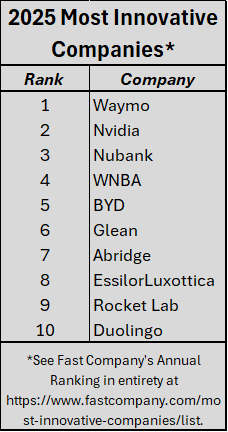
Each year Fast Company publishes its list of the top innovative companies throughout the world. A quick glance of the top ten (see inset) reveals a broad range of companies from various industries, including AI technologies, the food industry, fashion, and even professional sports. So, what could these organizations possibly have in common?
Innovative organizations like these revolutionize how we think about things, challenging the status quo and re-imagine paradigms. Innovative companies resist the temptation to continue down the common, comfortable path and embrace change head on. Many historical examples exist of companies that lost their market footing because they got stuck doing things and seeing things from a past perspective – Kodak, Xerox, and Blockbuster are just a few examples.
On the other hand, innovative organizations break barriers and dissolve the glue that often keeps us bound to mental models that are no longer relevant. They actively seek new information on emerging trends and philosophies, integrate new ideas, and bravely adopt new business models. The following article breaks down what you, as a leader, can do to revolutionize your organization and, better yet, your industry, or even the world! Like the leaders on this list, you too, can loosen the adhesive grip of conventional perspectives.
What role does the leader play in generating new ideas?
The biggest thing you can do as a leader is to first understand that at the root of innovation is the ability to convert knowledge into learning opportunities that generate unique solutions. Your job is to set the tone by establishing a culture and vision that supports and inspires learning. Unfortunately, as Gary Hamel, founder of Strategos and best-selling author on innovation points out, many leaders and organizational cultures are stuck in a mindset derived from the efficiency process model spawned during the industrialization era.[1]
This approach lends to risk-averse cultures that favor optimization over creativity. Although this top-down approach served a purpose, it hinders the learning and inventiveness necessary for innovation.
Business Model Barriers
The acquisition of external information (data, trends, customer feedback and so forth), is a vital first step in the innovation process; however, that information is only advantageous if your organization can use it to create new ideas and knowledge that translate into customer value. This process often means organizations must marry up new insights with their previous experiences and institutionalized knowledge. This can be a daunting task for incumbent organizations that are stuck in traditional “business as usual” modes.
Other barriers to knowledge sharing and learning can stem from the organizational power structures, hierarchical communication silos, overly bureaucratic policies, a fear culture that admonishes mistakes and promotes compliance, incentivizing individual performance and short-term goals, and homogenized perspectives. Many of these are carry-over philosophies of leadership from times past but are no longer effective if organizations want to remain competitive in a knowledge-based world.
Leading by Example
Let’s face it – change is hard. But it’s also necessary. As a leader, you must consider how the entire organizational system helps or hinders the information sharing and learning that drives innovation. Taking a page from the innovation transformation playbook at Whirlpool, leaders must address learning and innovation in the strategic vision, values, processes, management systems as well as the emotional drivers that provide intrinsic motivation.[2]
As the leader of the pack, it is no surprise that your approach to innovation can make a huge difference in how your organization deals with new information and adapts to changing environments. It is easy to get stuck in a prescribed viewpoint, especially if that perspective has elicited a track record of profits in the past. However, if you want your organization to achieve the innovation necessary to survive in today’s environment, it takes genuine commitment from leadership. It is not enough to espouse innovation goals; your actions must demonstrate your commitment.
For innovation to take root, it must be baked into the regular processes and structures of the organization. Does your culture align with learning? Do you provide the necessary resources – including time – for learning? Do you actively solicit new and different perspectives? Are there communication channels that cut across organizational divisions? What mechanisms are in place for feedback? Learning is everyone’s job in the knowledge era, but the example is set through your commitment.
How can leaders encourage employees to look to the future and embrace new ideas?
Hamel states it well, “Companies fail to create the future not because they fail to predict it but because they fail to imagine it.” A future smart mindset requires leaders to look to the horizon and imagine future possibilities that influence their present actions. [3] It’s not about knowing the future; it’s about adapting previous operating schemas when new information becomes available so that organizations can affect beneficial outcomes.
However, as Peter Senge points out in his book “The Fifth Discipline,[4]” organizations often fail to implement novel insights because of a conflict with existing, deeply ingrained mental models of how the world operates that drastically influence how one thinks and acts. Innovation can be seen as a threat to the re-engineering and “lean” efforts driven by the efficiency business model of the past. Yet, regardless of the sticky nature of the “this is how we’ve always done things” mentality, leaders CAN build innovation into the fiber of their organizations.
Vision & Core Values
The transformation starts with a vision and core values. Creating an innovative culture requires leaders to inspire change. A vision should push others to reach goals that challenge the status quo. It should motivate employees to break from complacency and emotionally compel them toward a future that stretches current viewpoints.
Building a shared vision requires identifying core values that establish acceptable norms, providing the underlying framework for making decisions and setting priorities. These values need to fuel innovation. Learning foundations require flexibility, honesty, courage, risk-taking, openness, creativity, knowledge sharing, curiosity, and trust.
Management Systems
Core values act as the guiding principles that should guide all the enabling management systems. As noted by Snyder and Duart in their account of Whirlpool’s innovation revolution, this means taking an honest look at all operational policies and updating them when they inhibit learning and creativity. For example, reward programs that incentivize only short-term goals or individual effort will serve to prohibit the forward-looking and collaborative behaviors necessary for information sharing and team ideation.
How is your budgetary and resourcing policy structured? Is it entirely profit-driven or are funds earmarked for experimentation and prototyping new ideas? Do your performance review practices hold supervisors accountable for learning and innovation within their areas? Are project reviews solely focused on present goals, or do they incorporate future thinking data and conceptual solutions? Does your organizational structure promote communication and collaboration across divisions?
Communication
Communicating your vision and the enabling values is critical to gaining support. As the leader, you influence what messages people pay attention to. You can provide context in meaning by sharing stories about learning through trial and error, painting heroes from incidents of calculated risk-taking, collaboration that led to “out of the box” solutions, and so on.
Communication is dynamic and ongoing, requiring leaders to also push pause to listen and solicit feedback from their constituents. It also means you must ensure that your behaviors are consistent with the values you espouse. When your actions match innovations goals, you build the trust and credibility needed to inspire commitment of others to seek out new ideas and challenge business as usual.
What mechanisms can leaders use to make sure that their organization stays ahead of the curve?
So, now that you have developed a compelling vision that pushes thinking beyond the status quo, and evaluated policies to ensure they elicit behaviors consistent with learning values, what are some best practices to ensure your organization stays out in front?
Environmental Scanning & Scenarios
Applying strategic foresight requires proactively and regularly scanning external sources to identify, analyze, and monitor trends, including changes in demographics, regulation, politics, the economy, public opinion, consumer behavior, the environment, culture, or technology.[5] Sources of information include conferences, industry journals, social media, benchmarking, crowdsourcing, and news media. The idea is to uncover any emerging anomalies that could point to a market shift in demand or an impending problem requiring a solution for which your organization may be able to address.
One way that organizations use this information is to develop scenarios of future possibilities. Scenario planning helps uncover underlying assumptions and envision different prospects uninhibited by bounded rationality.[6] Organizations can respond to a broad range of future outcome possibilities with greater agility by accounting for these change signals. Innovation comes from the ability to see over the horizon and imagine new ways of seeing and doing.
External Partnerships
In her book, “Wellsprings of Knowledge,[7]” Dorothy Leonard-Barton discusses how organizations can utilize partnerships to augment their core capabilities with external knowledge. She highlights that organizations can seek external knowledge through customers, venders, universities, consultants, national labs, and other companies. Sourcing mechanisms include licensing, R&D contracts, co-development, joint ventures, acquisitions or mergers.
However, Hamel cautions organizations not to fall victim to “strategy convergence.” Basically, there are limits to adopting inputs from other organizations if you wish to stay ahead of the curve. Taylor Swift Productions, ranked number 15 on Fast Company’s list for 2024, provides a great example of how to maximize partnerships in innovative ways, striking an unconventional deal with AMC Theatres to distribute her concert in movie format, a profitable venture for both parties.
Cognitive Diversity
It is easy to get stuck seeing and doing things the same way if you are surrounded by people who think the same or share similar experiences. To disrupt existing mental models, organizations must invite unorthodox perspectives. Hamel makes the point that junior people, who are often the most invested in the future, are seldom invited to strategy sessions but bring a vital viewpoint that can help senior leaders shed previous vantage points and adopt new frames of reference. Similarly, organizational newcomers can bring a different outlook that helps construct new ideas.
Neuroscientist Gregory Berns tells us that breaking the categories of perception drawn from past encounters requires exposure to novel experiences,[8] which suggests organizations should consider things such as travel opportunities, job rotations, temporary assignments, job shadowing, collateral duties and action learning teams to help diversify perspectives. As Leonard-Barton points out, knowledge can often exist in functional silos, and therefore organizations benefit from the cross-pollination of collaborative teams that span organizational boundaries and help make connections. This factor aligns with Senge’s systems perspective where learning must account for non-linearities and consider a more holistic perspective.
Experimentation and Failure
There is significant agreement among innovation experts that a key aspect to staying ahead of the curve is an experimentation pipeline. Experimentation allows organizations to integrate new information and test novel ideas before moving forward with a larger resource commitment. Experimentation tests ideas as reality. It also provides a diverse portfolio of options to consider and infuses innovative thinking into the organization’s veins.
However, not every experiment will succeed, and organizations need to promote a culture where failure is okay if they want to continue breeding innovative ideas. Harvard Business School professor and expert in psychological safety, Amy Edmondson, highlights that fear inhibits learning.[9] Therefore, organizations must create a climate where the idea of failure as learning is institutionalized. Leaders must set expectations about uncertainty, how failure can benefit learning, inquire about ideas, listen to feedback, and provide recognition of risk-takers.
Still unsure whether innovation applies to your organization?
You may be wondering, “Is innovation really necessary?” And the answer is a resounding yes. Think about the cultural revolution of the iPhone, Smart TVs, and electric cars. But also think about innovative services like remote healthcare, website chatbots, and self-service kiosks or even entire industry paradigm shifts unveiled by the likes of Uber, AirBnB, and Neftlix. There isn’t a company or industry that is not impacted by the need to innovate.
Impacts of Globalization and Social Media
Globalization and social media create a dual-headed monster changing the game of historical business models. There are now infinitesimal nodes of information and connections available around the world, often in real-time exchange largely unhindered by political, geographic, or social barriers. This environment creates a non-linear, dynamic, and complex environment where continuous learning is a must. Staying ahead of the game is essential to an organization’s survival. Therefore, the ability to acquire and share new information is critical to an organization’s success.
Globalization also presents unique challenges that cut across industries and economic borders, requiring innovative solutions. These worldwide issues, such as climate change, extreme poverty, food security, health pandemics, and aging populations,[10] require solutions derived from the knowledge sharing of organizations around the world. Hence, you have an opportunity to influence not only your organization’s or industry’s outcomes, but you can influence consequences in the global domain.
The Artificial Intelligence (AI) Revolution & the Next Technology Supercycle
According to futurist Amy Webb during a recent podcast,[11] artificial intelligence represents an example of how technology disruptions can have far reaching impacts across many differing industries. As maintained by Webb, the goal of seeking future-forward information isn’t to prepare you for everything, but anything. She offers the metaphor that we need to be willing to steer into the ice rather than turn away from the challenges; essentially, we need to lean into the unknown and the uncomfortable.
Webb reminds listeners that the idea of artificial intelligence has been around since 1956 at Dartmouth College, yet many organizations seem surprised by the recent ascension of AI technologies. When organizations don’t seek and incorporate new information because it disrupts the business-as-usual archetype, they miss the opportunity to innovate and can easily lose their competitive advantage. As happened with the AI revolution, how many of you will miss the next technology super-cycle because it’s more comfortable to stay glued to the status quo?
Conclusion
For organizations to remain competitive, innovation is a must, at the root of which is learning; yet organizations often get stuck in the paradigm of former business models that prioritize efficiency over creativity. Innovative organizations embrace new information and ideas, pushing beyond the boundaries established by former models of success. Leaders of these organizations enable a culture of learning, where out of the box thinking, experimenting, sharing knowledge, and different perspectives are rewarded.
With commitment, an inspiring vision, guiding values, enabling management systems and structures, and strong communication, you too, can lead your organization to embrace the mechanisms required to stay ahead of the curve. In doing so, you can dissolve the adhesive that draws organizations to past ways of thinking, and perhaps find your organization on the next list of top innovative companies.
How has your organization clung to the status quo and missed opportunities to innovate?
[1] Hamel, G. (2002). Leading the revolution: How to thrive in turbulent times by making innovation a way of life. Penguin Group.
[2] Snyder, N. T., & Duarte, D. L. (2008). Unleashing innovation: How whirlpool transformed an industry. Jossey-Bass.
[3] Canton, J. (2015). Future smart: Managing the game-changing trends that will transform your world. Da Capo Press.
[4] Senge, P. M. (2006). The fifth discipline: The art & practice of the learning organization (Revised and Updated.). Currency.
[5] Cornish, E. (2004). Futuring: The exploration of the future. World Future Society.
[6] Chermack, T. J. (2011). Scenario planning in organizations: How to create, use, and assess scenarios. Berrett-Koehler.
[7] Leonard-Barton, D. (1995). Wellsprings of knowledge: Building and sustaining the sources of innovation. Harvard Business School Press.
[8] Berns, G. (2008). Iconoclast: A neuroscientist reveals how to think differently. Harvard Business Press.
[9] Edmondson, A. C. (2019). The fearless organization: Creating psychological safety in the workplace for learning, innovation, and growth. John Wiley & Sons.
[10] Global Issues (n.d.). United Nations. Retrieved on May 31, 2024, from https://www.un.org/en/global-issues
[11] Brown, Brene. (Host). (2024, April 24). Futurist Amy Webb on what’s coming (and what’s here) [Audio podcast episode]. Dare to Lead. https://brenebrown.com/podcast/whats-coming-and-whats-here/