There is wide recognition that an organization’s culture has a significant impact on its performance. Every organization’s culture is unique, encompassing the shared learning of its beliefs, values, assumptions, and behavioral norms. When these underlying principles that drive decision-making and action are misaligned or contradict the espoused vision and goals, progress stagnates and can even create a toxic environment of mistrust. Examples of symptoms include poor performance, low job satisfaction, and team conflict.
Yet, it can often be difficult to articulate the culture because it is typically so embedded that members take for granted the deeply rooted norms and expectations. Aligning with the extensive research of organizational culture expert, Edgar Schein, we take a multi-pronged approach to discerning an organization’s culture based on three areas: explicit beliefs, artifacts, and implicit assumptions.
| Method | Examples | |
| Explicit Beliefs | Review | Strategic plan/vision statements Timekeeping policy Promotion policy Hiring policy Decision procedures Performance/reward systems |
| Artifacts | Review | Organizational charts Seating arrangements Indoc packages Recruiting flyers, pamphlets Exit interview data Organizational demographics Internal/climate survey data |
| Implicit Assumptions | Interviews | Senior leadership Division leadership Functional area leadership Support staff – IT/Facilities/Finance Administrative staff Mid-level employees Entry-level employees |
Upon analyzing this information, we will generate a report with our findings and research-based recommendations for modifying the culture to achieve greater alignment with your strategic vision and improve overall organizational effectiveness.
Contact us at admin@otherleadership.com to discuss an organizational culture consulting plan specific to your organization.
Organizational Culture Assessment Instrument (OCAI)
An additional tool, the Organizational Culture Assessment Instrument (OCAI), developed by Kim Cameron and Robert Quinn at the University of Michigan, is also available to evaluate the current culture and how it matches up with the desired future state. The OCAI tool has been used for the past thirty years across a broad range of industries to effectively diagnose culture. It can also be used as a tool to compare internal cultures.
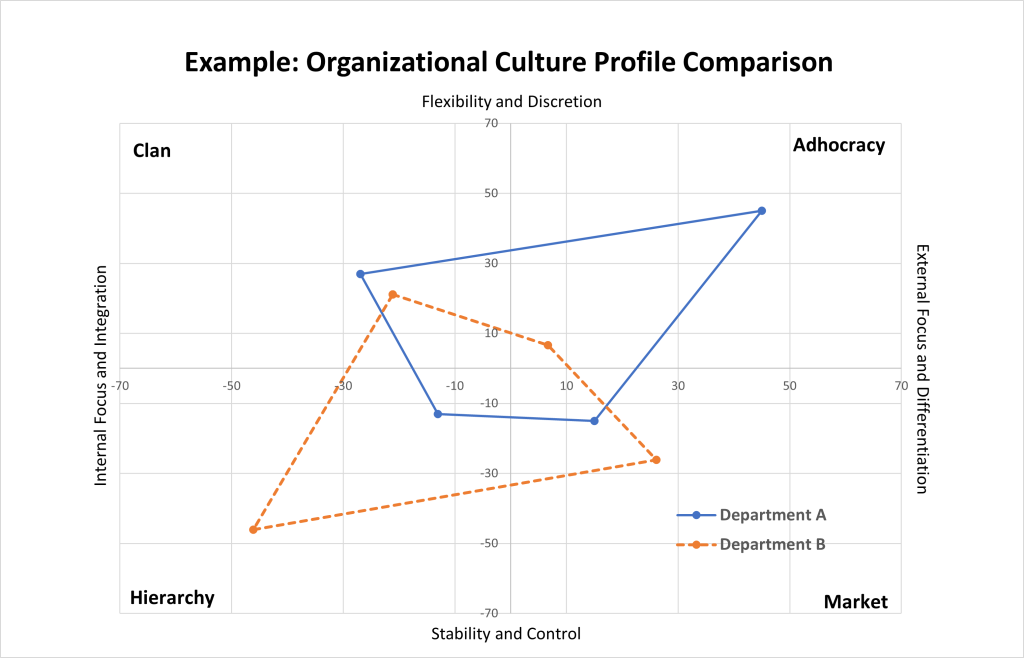
This tool involves a survey provided to organizational members, or a sample thereof, using a point distribution system to rate four possible responses across six areas: the culture’s dominant characteristics, organizational leadership, management of employees, organizational glue, strategic emphasis, and criteria of success. When the average results are plotted they provide a pictorial representation of the organizational profile across four quadrants formed by competing values. An example is shown below.
Ideally, using both types of assessment will provide the most robust picture of your organization’s culture and offer insights on how to better align with your strategic vision and goals; however, we recognize resource constraints play a role. We can help you decide which options are best suited to your specific needs.
Contact us at admin@otherleadership.com to discuss a tailored consulting strategy.