
Developing and retaining an organizational pipeline of leaders is more critical now than ever. Succession planning is an effective strategy to ensure your organization can achieve performance continuity and develop the strategic competencies required to adapt to future challenges. Developing a pool of talented leadership provides organizational agility to respond to environmental turbulence.
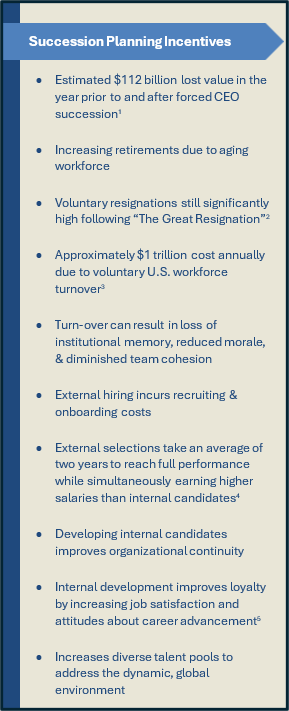
Often, organizations fail to invest in their potential resources, causing costly gaps when attempting to backfill vacancies. These organizations risk incurring costs due to lost market value, hiring and onboarding, loss of institutional memory, team disruption, external hiring transition times, and cascading effects that impact organizational morale and loyalty.
On the other hand, organizations that employ a proactive succession management plan continuously develop their leaders to reach the organization’s full potential. Effective succession planning provides organizational resiliency, improves retention, and positions the company with future-focused leadership competencies. These organizations leverage leadership development as a competitive advantage using a succession planning strategy.
Highlighted below are some key tenets of successful strategic leadership development that guides our consulting.
Ongoing Senior Leadership Commitment & Accountability
Successful succession planning requires the participation and commitment of senior leadership within the organization. It needs to be embedded as part of the corporate culture. It is not a process that leaders can just hand off to the HR team; instead, it requires personal involvement from the executive team. The senior leadership team sets the example and drives expectations within the organization.
In an MIT Sloan Management Review article, former IBM CEO Sam Palmisano states, “One key to our success over the past decade has been that we established leadership development as a top corporate priority. Every IBM manager and executive is accountable for identifying and developing leaders. We are completely committed to this principle as one of the cornerstones of our core values.”
Effective succession planning commitment requires senior leader collaboration to reach across functional areas when crafting development plans for identified high potentials. This process can sometimes mean losing a current high performer within one’s division, which is why succession planning must be driven as a priority from the very top.
Organizations should consider tying employee development to performance evaluations and incentivizing succession planning activities such as mentoring and coaching.
Organizations cannot simply put a check in the box of succession planning. The commitment to succession planning must be ongoing. Many successful organizations, including IBM, incorporate succession planning reviews as an agenda item at quarterly meetings.
Long-Term Approach – Identify Future Competencies Aligned with Strategic Goals
It is not uncommon for organizations to reward high performers with promotion opportunities. Although this seems intuitive and can sometimes work out, organizations must understand desired future competencies that align with longer-term strategies. High-potential identification should align with the probability of the individual’s ability to develop the necessary competencies for future leadership roles.
The complex and dynamic nature of the global environment means that key positions and the necessary competencies needed today may not be the same as those required in the future. Organizations must analyze their strategic goals and develop competency models that align.
When managers identify high-potential candidates, a necessary first step is to clarify the desired values and competencies for future positions. Competency should not be based on the incumbent but should reflect the organization’s changing needs. This identification can be a moving target, further necessitating the ongoing nature of succession planning and allowing for continuing adjustments.
Develop a Deep Bench of Diversified Leadership Candidates
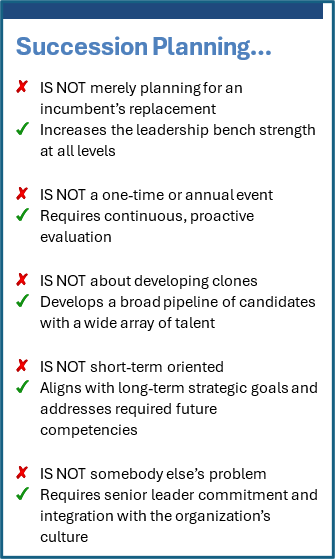
Succession planning is not the same as replacement planning. The goal is not to pick a top candidate and groom them to take over a particular role. The selection of an heir apparent severely limits the pipeline for a position, which can cause a significant threat to the continuity of operations if that person decides to leave the organization.
Instead, succession planning aims to increase the bench strength for key positions by proactively developing a pool of diverse candidates with a wide array of talent. A succession plan that broadens the pipeline with several high potentials mitigates risks to operational continuity if a candidate leaves or environmental demands shift. Evidence also shows that investing in employee development can positively affect retention by improving career attitudes and feelings of job security.
Organizations must be mindful of the tendency for leaders to assess potential based on similarity to themselves. There is an often-unconscious propensity for executives to clone themselves when developing successors; however, this leads to homosocial reproduction that reduces varied perspectives, knowledge, and skills required for the agility today’s turbulent environment requires for organizations to adapt effectively.
Leadership Development Advantage
It is undeniable that today’s organizations face complex challenges and constant change. This knowledge-based economy puts a premium on talent. Organizations that can attract and retain talent are at an advantage.
But there’s more. Developing a pipeline of leadership successors with the competencies required to adapt in this dynamic environment can provide the competitive strategy your organization needs to outpace other organizations.
The research shows that external hires are costly. Not only do they typically demand higher salaries, they also take roughly two years to adjust to the new organization’s culture and may not even be a good fit. On top of that, value lost from turnover, customer satisfaction, and recruitment costs all come into play.
On the other hand, organizations that invest in their employees increase loyalty and overall career satisfaction. They build a leadership culture focused on developing an array of skills and perspectives, providing the flexibility of future-focused competencies necessary to provide a competitive advantage.
Why waste time and money looking for talent elsewhere when you can have a pool of internal candidates poised and ready to step in and step up when needed? We can help you create this leadership development strategy.
Contact us at admin@otherleadership.com to discuss a leadership development consulting plan that works for your organizational needs.
1Favaro, K., Karlsson, P-O, & Neilson, G. L. (2015, May 4). The $112 bilion ceo succession problem. Strategy+Business. https://www.strategy-business.com/article/00327
2Ferguson, S. (2024, January 9). Understanding America’s labor shortage. U.S. Chamber of Commerce. https://www.uschamber.com/workforce/understanding-americas-labor-shortage
3McFeely, S., & Wigert, B. (2019, March 13). This fixable problem costs U.S. businesses $1 trillion. Gallup. https://www.gallup.com/workplace/247391/fixable-problem-costs-businesses-trillion.aspx
4Bidwell, M. (2011). Paying more to get less: The effects of external hiring versus internal mobility. Administrative Science Quarterly, 56(3), 369-407. https://doi.org/10.1177/0001839211433562
5Ali, Z., & Mehreen, A. (2019). Understanding succession planning as a combating strategy for turnover intentions. Journal of Advances in Management Research, 16(2), 216-233. https://doi.org/10.1108/JAMR-09-2019-0076